
Richland County Previous Residents by Era
Past residents and past owners are often found in different records. The county property card begins the present parcel trail. The Register of Deeds records transfers, while directories and telephone listings can place a published name or address in a particular edition. State Archives collections reach earlier property and tax series. Federal census releases provide a household snapshot under the National Archives 72-year schedule. Read the rows as evidence routes, not as interchangeable proof of occupancy.
| Source | Years It Covers | Where Held | What It Shows |
|---|---|---|---|
| Property Record Card | Current roll; start date not published | County property portal | TMS, legal description, owner/mailing/situs distinction, and sale-history book/page |
| ROD online index | 1984-present | Subscription service | Names, dates, property or legal-description paths, and book/page |
| ROD online images | 1998-present | Subscription service | Instrument images within paid current coverage |
| ROD historic access | Before relevant online bands | Room 101, books, and microfilm | Grantor/grantee and other historic indexes |
| SCDAH conveyance books | 1865-1951 | South Carolina Archives | Historic conveyances after the courthouse-fire gap |
| Columbia digital directories | Selected 1859-1927 | University of South Carolina | Named entries and Street & Avenue departments |
| Hill and Polk directories | 1929-79 and 1985-97, with gaps | Walker Center and Main Library | Later edition-by-edition directory bridge |
| Federal census | Released on a 72-year schedule | National Archives and library-access services | Household snapshot, separate from recorded owner |
| Sanborn maps | 1888, 1919, and 1950 | Library of Congress | Street and building context for each map year |
Use the source nearest the question's date. A current card is a strong way to identify a parcel, but it cannot answer an early household question by itself. A directory listing can add a period address, but it should not be substituted for a deed or census record. The access route changes when the date crosses a local collection boundary.
Richland County Previous Residents Begin with TMS
The free Richland County Property Record Card is the right starting place for an address, owner, or tax-map question. It leads from street address to Tax Map Number, also called TMS, and then to the legal description and sale-history book/page information. The record card separates the situs, which is the physical parcel location, from an owner mailing address, which is where tax correspondence goes. That split prevents an unsupported conclusion that an owner lived at the situs.
| Tax Map # | Autocomplete parcel or TMS lookup. |
|---|---|
| Address | Autocomplete street-address search with suggestions. |
| Owner | Autocomplete owner-name search. |
| Transaction Date | Optional start and end date range. |
| Transaction Price | Optional numeric range. |
The card can show TMS and account number, legal description, neighborhood, zoning, sale history, book/page, transaction date and price, grantor and grantee, along with other tax and building fields. Searches are limited to 300 results, exports to 100. Online owner fields can be opted out, so a partial card is an access-state observation, not proof that no county record exists.
Richland County Previous Residents and Deed Chains
A deed chain tracks recorded transfers, not everyone who may have lived at a location. Use the property card's book/page or party information to enter the Register of Deeds trail. If an instrument does not carry an address or TMS, the legal description, date, and recorded party names are stronger bridges. The ROD subscription system recognizes Instrument Number or Book and Page, Names, File Dates, Property Address, and Legal Description, and its Book Index includes mortgages, deeds, liens, plats, releases, and UCCs.
- Search the property card by exact address or owner, then record the TMS, situs, legal description, and every sale-history book/page or grantor/grantee value.
- Use Book/Page in the ROD when a sale entry supplies it. Otherwise search the current owner as grantee and the seller as grantor.
- Test a date window, legal description, and recorded-name variations. The ROD documents the
%wildcard and notes that full names, middle initials, and corporate abbreviations matter. - From the older instrument, follow the predecessor reference, earlier party role, legal description, tax-map clue, or plat clue. Do not assume the street address appears on every deed.
- When the online boundary ends, switch to the Room 101 public viewer, historic books, or microfilm and continue from the recorded land identifiers.
- Grantor / grantee
- The grantor is the party transferring an interest. The grantee is the party receiving it on that recorded instrument.
- Chain of title
- The sequence of recorded transfers linked by parties, book/page references, dates, and legal parcel descriptions.
- Legal description
- The formal parcel wording used in land records. It often connects older instruments more reliably than a street address.
- TMS
- The county tax-map identifier used to carry a parcel from the first property search into map and land-record research.
The Richland County Register of Deeds page is the official entry point for the office and its subscription-based online service.
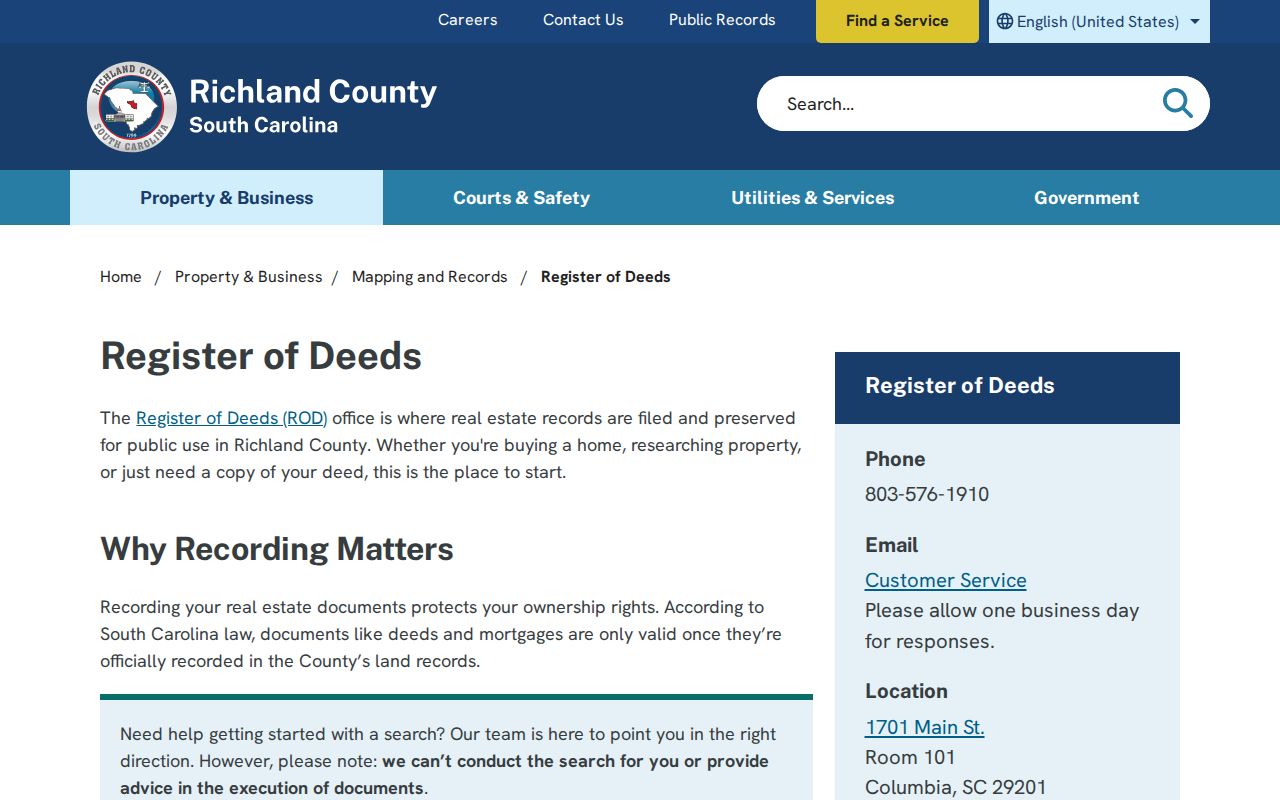
Keep the subscription search and the public counter route together in a deed plan, because historic material may require Room 101 even when a later instrument is online.
Richland County ROD History Cutoffs
Richland County has two separate online boundaries. The searchable ROD index begins January 10, 1984. Online images begin February 19, 1998. A 1990 deed can therefore be indexed without an online image. Before the relevant boundary, use the ROD's in-person public viewer, microfilm, and the grantor/grantee, mortgagor/mortgagee, lien, plat, or UCC books. Tax-lien search begins in 2000, a third boundary that should not be confused with the deed index or image date.
| Party names | Indexed as recorded; a name search displays the searched name only. |
|---|---|
| Instrument detail | Document type, book/page with book-type prefix, and recorded date/time. |
| Placement fields | Instrument or book/page, name, file date, property address, and legal description. |
| Tax-map number | May appear in an optional summary, but it is not required on every instrument. |
| Image route | Paid online image access in coverage; counter or public viewer for older or incomplete material. |
Address-only and TMS-only searching can miss a record because neither field is required on every recorded instrument. A name or legal-description search may be the better route. The online split is a local research fact, not a reason to stop the trail.
Note: Write down the index date and image date separately, because they send a deed search to different ROD access channels.
Richland County Previous Residents in Directory Years
Once the deed chain establishes a parcel period, use directory and census records to look for the household layer. The Richland County Directory Book describes the collections themselves. Here, the goal is narrower: compare the address wording and name form in one actual edition with a census release, map edition, obituary notice, probate estate, or land record. A vanished listing can reflect a gap, a name variation, a publisher omission, or an address change, so it does not establish a departure or death.
- Choose the directory edition closest to the ownership or address period and record its exact year and wording.
- Use a Street & Avenue, criss-cross, or telephone section when the address is the first known fact.
- Compare the next available directory edition, preserving name variants and street changes instead of forcing continuity through a gap.
- Pair the observation with a federal census available under the 72-year release schedule for a household snapshot.
- Use an obituary index, probate file, deed of distribution, or later transfer to test an estate transition, rather than inferring one from an absent listing.
The 1911 Walsh Columbia directory is an example of the locally digitized address and name material used in this comparison.
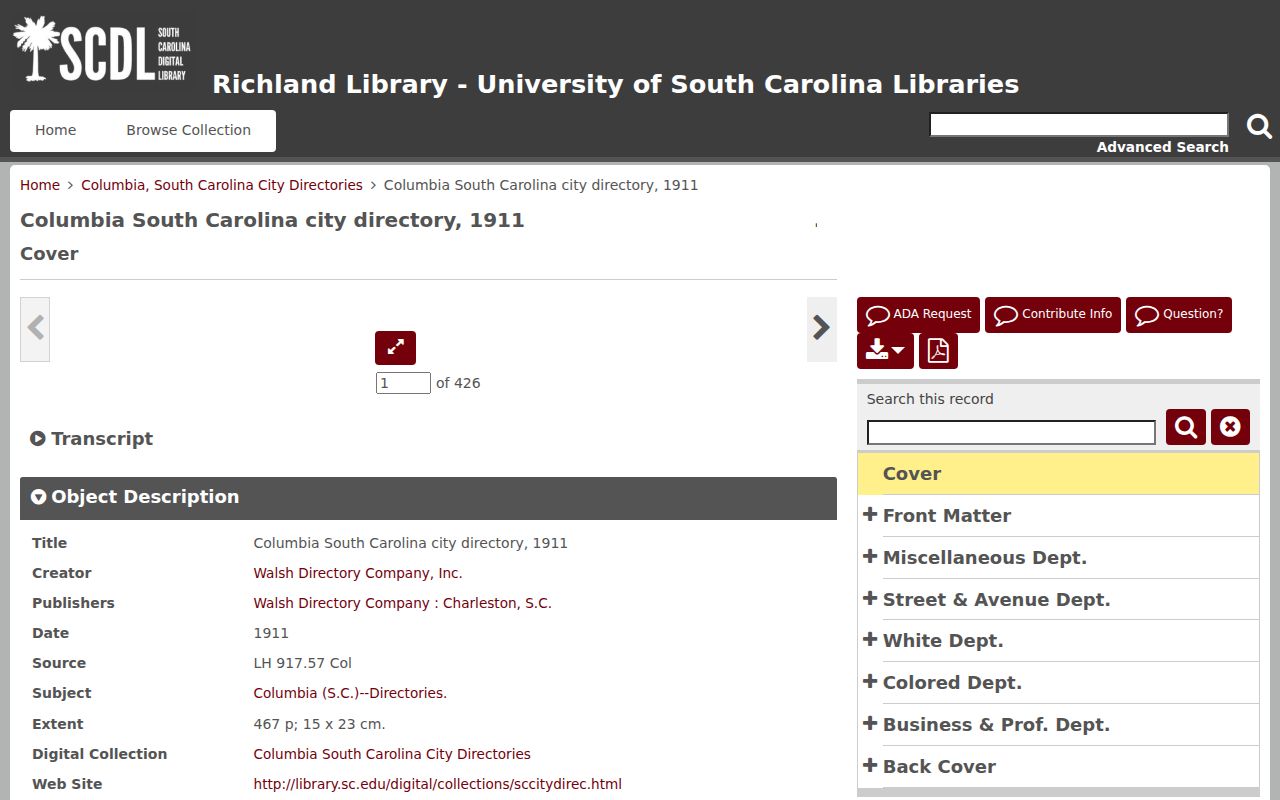
Its Street & Avenue department is useful for a dated address lead, while its alphabetical material can return the search to a published name form.
Richland County Past Residents at Walker
No standalone official Richland Library service for identifying everyone who lived at a particular house was found. The defensible local support is the Walker Local and Family History Center, which offers research appointments, directories, maps, newspapers, local magazines, yearbooks, oral histories, and obituary resources. It is at Richland Library Main, 1431 Assembly St., First Level, Columbia, SC 29201, and lists 803-929-3402. Walker is a library access channel, not a private-records service.
The Walker Center page identifies the collection and appointment route for this kind of historical address research.
Bring the TMS, legal description, directory edition, and date range to the library so staff can route the question toward a collection rather than treat it as a current-person search.
Richland County Past Residents on Sanborn Maps
The Library of Congress Columbia Sanborn maps provide 1888, 1919, and 1950 editions. They can show whether a street or structure existed in a mapped year and help compare a historical address with a parcel trail. The maps do not name a household. Use them to test building and street context before connecting a directory line to a particular parcel.
Columbia's planned-grid origin in 1786 explains the value of its Street & Avenue departments and plats, yet later municipal and postal variation still matter. No verified countywide renumbering year was found. A map edition, legal description, TMS, and deed reference are safer than assuming an old and modern address are the same.
The 1865 Richland County Fire Story
The February 1865 fire during federal occupation of Columbia destroyed the courthouse and most records. The South Carolina Archives Richland County guide also states that most equity and probate records had been removed safely. That combination changes the route for an early address trail. Look to surviving equity and probate material, then to the post-fire conveyance, tax, and court series, rather than treating an absence in a modern system as a personal conclusion.
The SCDAH Research Room at 8301 Parklane Rd., Columbia, is the in-person path for county-record microfilm indexes and county or municipal microfilm. It also lists census, county wills, death-certificate indexes, and church, newspaper, and private records. Posted hours are Tuesday through Friday, 8:30 a.m. to 5 p.m., and Saturday, 8:30 a.m. to noon and 1 to 5 p.m.
The Archives holdings guide documents the loss and the surviving Richland record groups.
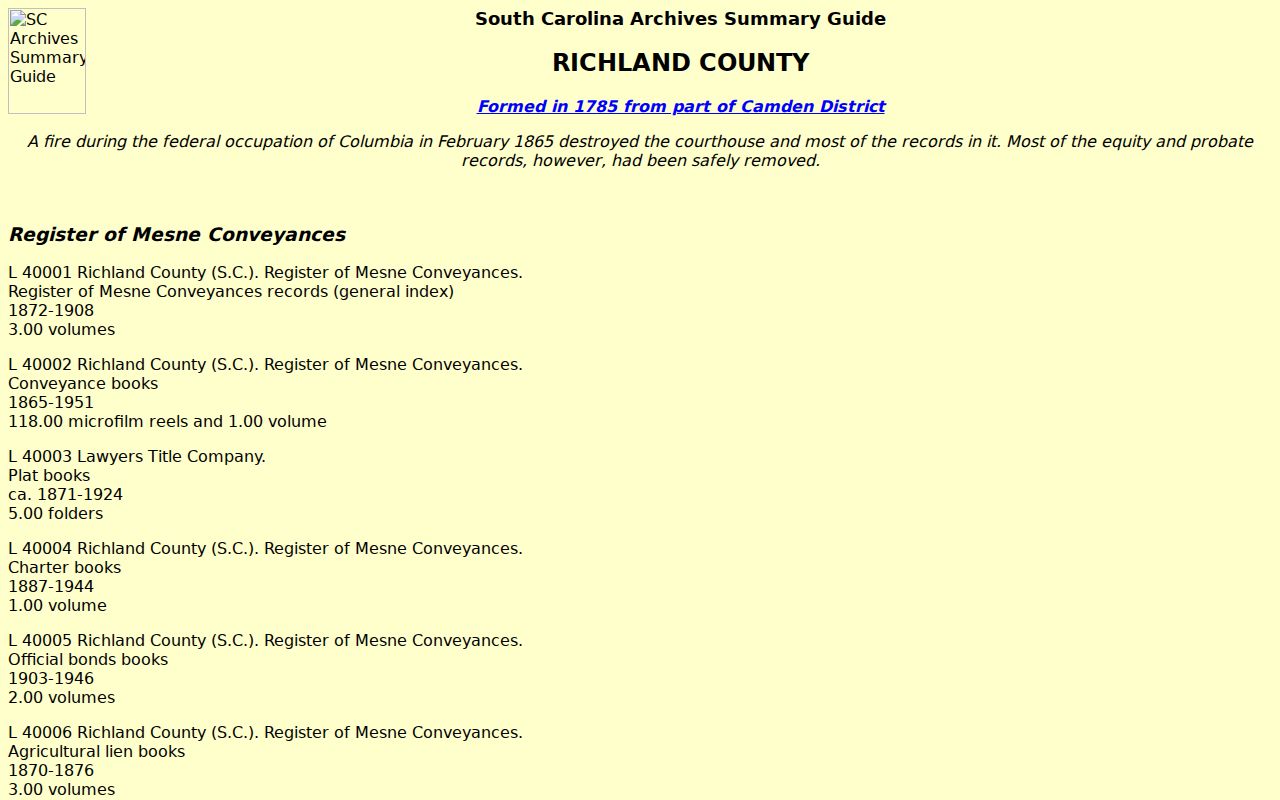
Its documented post-fire conveyance books run from 1865 to 1951, while the general RMC index runs from 1872 to 1908, creating practical recovery paths for the historic trail.
Richland County Past Residents: Closing Household Evidence
Use the Richland Library Local History & Obituary Index when a directory or deed sequence suggests a death notice or local-news lead. If an estate appears, Richland Estate Inquiry covers estates filed after 1983; earlier estate files are at Probate Court. An estate result is a lead, not the complete file, and availability of documents can vary. Keep the address, record date, party role, and source type separate in the final research notes.
Lawful use. Previous-resident research is appropriate for family history, estate matters, and personal address history. South Carolina law prohibits records use to harass, stalk, threaten, or harm a person, and a record should never be used to watch or confront someone.