
Richland County Resident Lookup Record Paths
A name is only a starting point in Richland County. The record that can confirm a fact depends on the question. The county property card is useful for an owner of record and the parcel identifiers tied to that owner. The court index can show a named party, court agency, case number, actions, and dates. Probate can provide an estate lead. Marriage and other vital records follow their own confidentiality rules. Historical directories, obituaries, and yearbooks are time-stamped evidence, not present-address proof.
| Record | What It Confirms | Where | Access |
|---|---|---|---|
| Property roll | Owner of record, TMS, situs, legal description, and sale-history clues | Richland Property Record Card | Free search; online owner fields may be opted out |
| Trial-court index | Party role, case identifier, agency, actions, and date trail | Richland Trial Court Public Index | Free index after disclaimer; some documents or cases are unavailable |
| Probate estate | Estate case lead, fiduciary, and file route for a decedent | Estate Inquiry | Basic index after 1983; earlier files are at Probate Court |
| Marriage record | County marriage-license copy or qualifying statewide certificate | Richland Probate and South Carolina DPH | Eligibility, identification, and date limits apply |
| Voter registration | An individual’s authenticated registration and precinct information | SC Votes | Self-lookup route, not a public name-only roster |
| Historic local sources | Edition-specific address, phone, obituary, school, or family-history lead | Walker Local and Family History Center | Library and digital-collection access varies by item |
For a current property question, begin with the county card. For a court question, begin with the court and date. For a past household, use an edition-specific library source and then corroborate it. The result becomes more reliable as the same identifying detail appears in independent records.
Looking Up a Richland County Court Name
The Trial Court Public Index is a case index, not a person locator. Select Richland County and accept the disclaimer before searching. The state’s guidance favors one or two filters at first. A surname alone can retrieve several people, so compare the first name, suffix, party type, agency, case class, and date range before deciding a result relates to the resident in question. For a Columbia city case, select Columbia Municipal Court in Court Agency. The City says its published online coverage is 1988 to present.
| Field or Control | Use in the Richland form |
|---|---|
| Search By / Court Type | Dropdown that narrows the court or case grouping. |
| Court Agency | Dropdown for a specific agency, including Columbia Municipal Court. |
| Case # and Case Type | Exact case number or a civil, criminal, appeal, or related type choice. |
| Case SubType | A dependent dropdown for a further classification. |
| Last Name / Business | Partial-name search with Begins With and Contains modes. |
| First / Middle / Suffix and Party Type | Name refinement and role selection, such as plaintiff or defendant. |
| Action Type and Date Type | Filters for actions and filing, disposal, judgment, arrest, or other applicable dates. |
| Tax Map # and civil scopes | From/through fields plus civil-index and cross-index scope choices. |
The Columbia Municipal Court instructions show the same county-search route used for its case information.
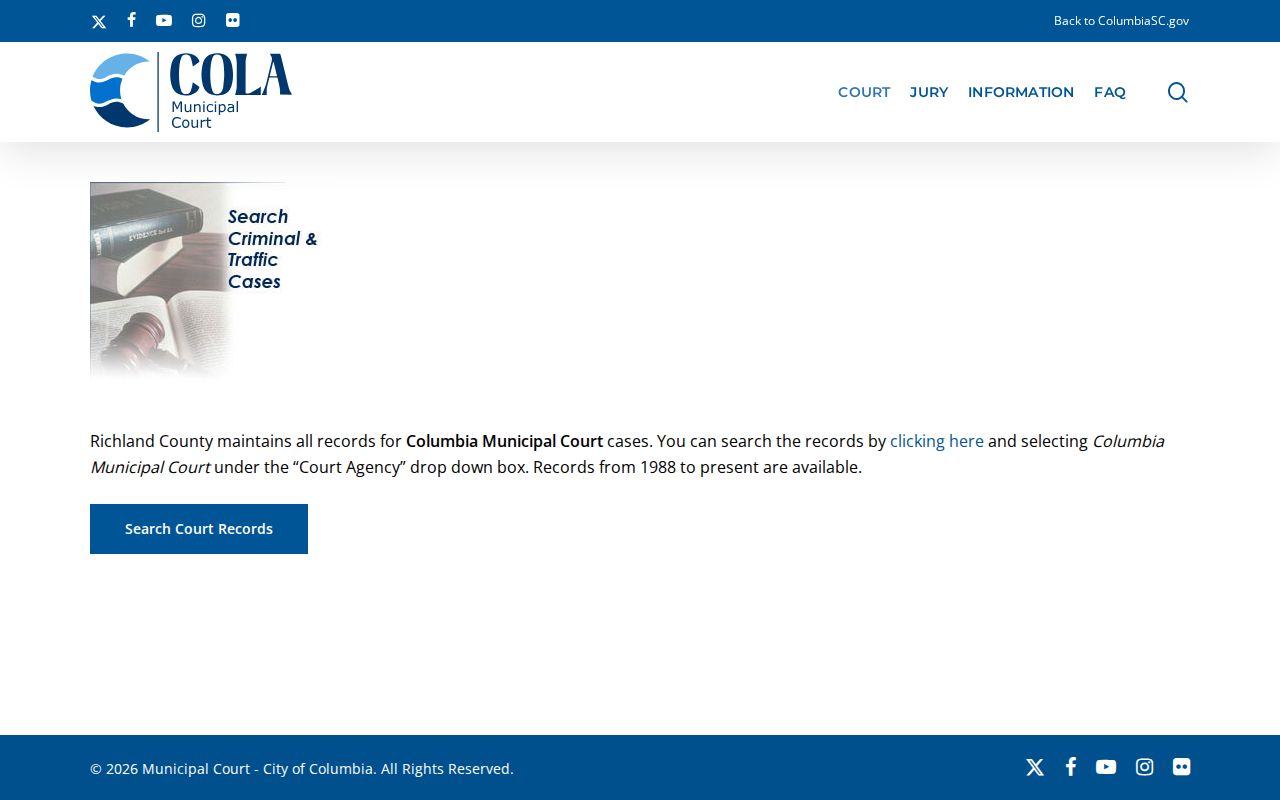
A returned case should be checked against its case number, party role, court agency, and dates. Sealed, expunged, juvenile, adoption, protected family, and commitment material follow separate access rules and may not appear.
- Case number, used to open the case detail.
- Party and court or case classification, interpreted with the search filters used.
- Actions and Financials tabs, with an all-information view and documented multiple-party toggle.
- A document icon only where an image is available, not as a promise that every filing has an image.
The Clerk of Court, rather than a general records request, is the route for a file or copy question. A case caption alone does not establish personal identity, current residency, or availability of the complete file.
Richland County Resident Property Records
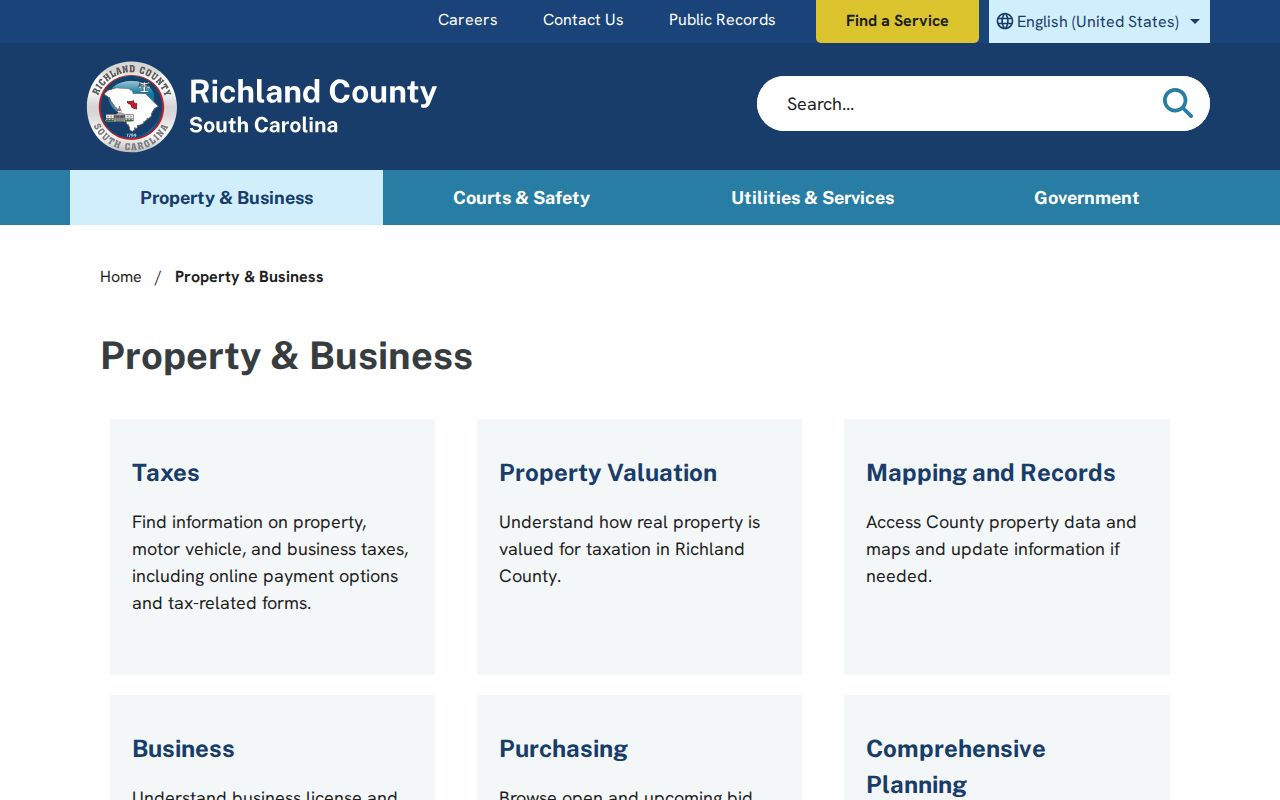
The county’s Property & Business entry point describes searches by tax-map number, address, or owner. The Property Record Card can return a TMS, account number, owner and owner mailing address, situs, legal description, tax district, property details, and sale history. These are parcel facts. The owner mailing address is a correspondence field, and the situs is the physical parcel location. Neither one establishes who currently lives there.
The official county property-search entry shows the three starting keys used when you look up a resident in Richland County.
Use the TMS and legal description as persistent identifiers when a name or street spelling changes. The portal limits a search to 300 results and export to 100, so a broad name or street query may need narrowing. A record can also display an online opt-out, which means the web card is partial rather than that no custodial record exists.
Note: A sales-history book and page can lead to a recorded instrument, but recorded parties still require an identity check from another source.
Verifying a Richland County Resident Record
Use one stable detail to test a name across systems. A property identifier, known court number, exact event date, or dated directory entry is stronger than sending a broad surname through every database. The sequence below keeps each custodian’s record type in its proper role and helps avoid confusing two people with the same name.
- Search an exact property address or owner, then record the TMS, situs, legal description, and the owner-mailing field separately.
- Use a sale-history book and page, or the recorded name and date range, to check the Register of Deeds trail. Test middle initials and name variants.
- For a court question, search the Public Index with the name plus a party type, court agency, action, or date range. Compare the case number and role.
- For a deceased person or heir question, check Estate Inquiry after 1983, then use Probate Court for earlier files or file access.
- Request a copy only from the keeper that controls it, and treat an unavailable, sealed, opted-out, or absent web result as a reason to use the documented counter, library, archives, or request route.
- Docket
- The court’s running case activity record, including actions and dates. It is not a finding that a named party is the person you seek.
- Index
- A searchable list of record references. It can lead to a case or instrument without providing the complete underlying file.
- Image
- A scanned record page when the custodian makes one available. An index result does not guarantee an image.
- Certified copy
- A copy issued and authenticated by the lawful custodian for the record, subject to that office’s procedures and eligibility rules.
Richland County Marriage Record Routes
Marriage material is not an open current-name locator. Richland County Probate Court is the local issuer and keeper of county marriage licenses, while the South Carolina Department of Public Health holds statewide marriage certificates from July 1950 through December 2023. The local Probate search is a Party A and Party B certified-copy route. DPH certificate access is controlled by relationship, identification, and statute, not by a simple name match.
The Richland Probate certified-copy search is the appropriate county channel for a qualifying local license copy.
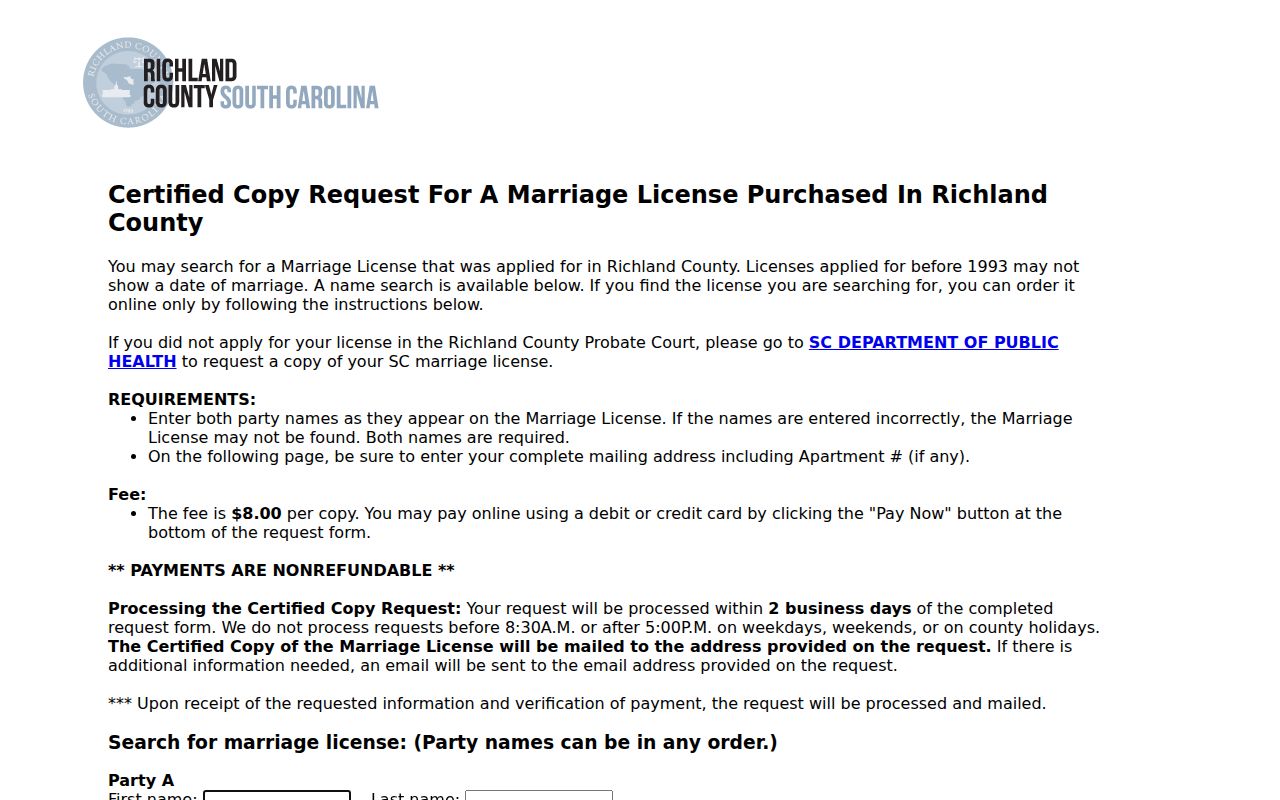
For a statewide certificate within DPH’s published span, the requester must use the state procedure. Parties, adult children, current or former spouses, and legal representatives have stated routes. Other requesters may be limited to a statement of occurrence, date, and county when allowed.
The DPH marriage-certificate page explains the state’s certificate channels, identification requirements, fees, and current service notices.
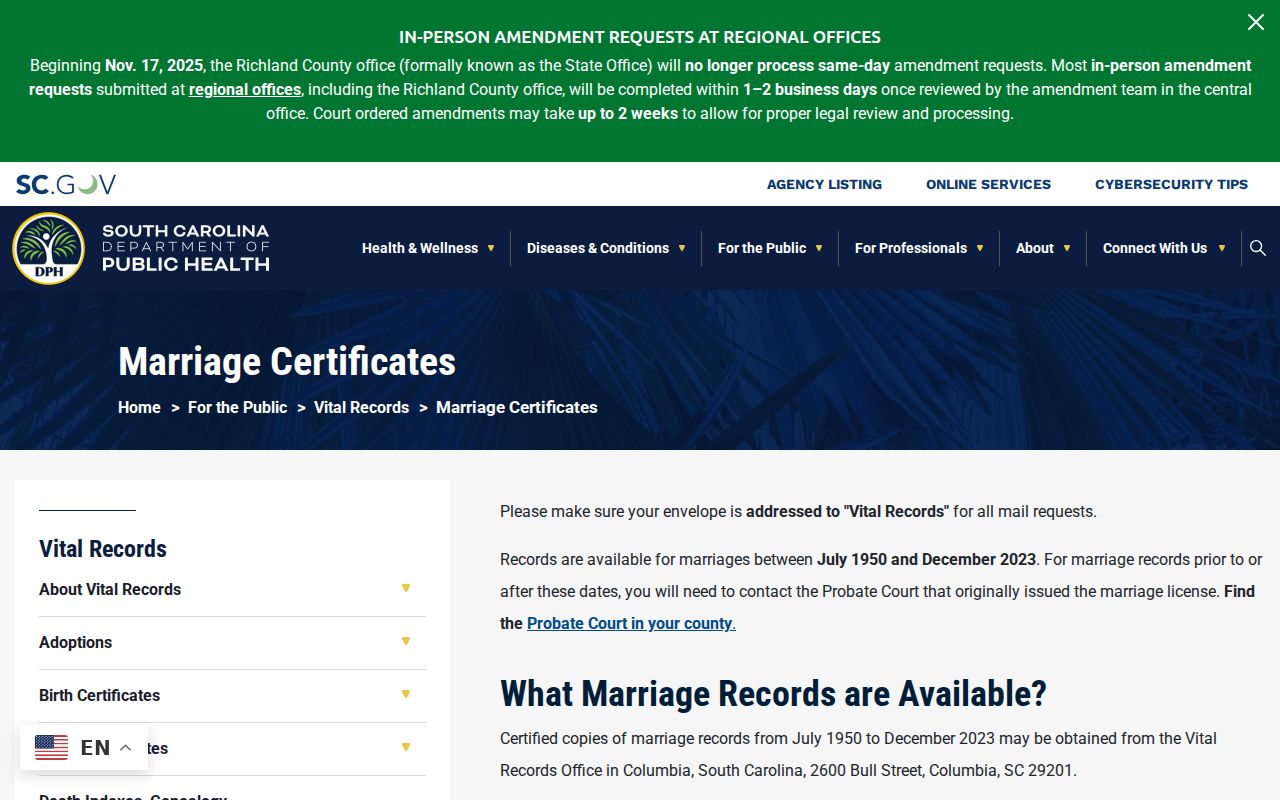
DPH lists a $12 nonrefundable search fee that includes one certification if found, $3 for an added same-type copy, and a current photo-ID requirement. In-person, mail, and authorized ordering-provider routes have separate timing and charge details. Its dated service notice should be checked immediately before relying on in-person availability.
Richland County MyscVOTES Record Boundaries
SC Votes provides an individual registration and precinct path. The authenticated MySCVotes route requires county, name, date of birth, and the last four digits of a Social Security number for an individual’s own lookup. It is not a public street-by-street or name-only household directory. County Board administration and statutory public-record channels remain separate from the self-service screen.
The state election lookup is shown here as an individual-registration route, not a general resident list.
Address confidentiality protections can limit voter and other government records. Use the record only to answer the narrow civic question the custodian supports, then corroborate the person through an appropriate independent source if identity matters.
Richland County Resident History Leads
For a family or estate question, the best route often changes with time. Estate Inquiry provides a basic name index for estates filed after 1983, while earlier estate files are at Probate Court. A probate case can lead to a fiduciary, date-of-death detail, or deed distribution. It is a lead, not a complete file. The related court controls and copy rules still apply.
For a past household or former classmate, the Walker Local and Family History Center supplies city and telephone directories, obituary and newspaper resources, yearbooks, maps, oral histories, and appointments. Its local resources are especially useful when a present-day official index cannot reach an old address. Record the publication year, page, spelling, and context, then corroborate with an estate, deed, census release, or other custodial record.
South Carolina’s unclaimed-property program can be a careful reconnection lead for a person, estate, or organization. A matching name does not prove ownership. The claim process requires its own documentation.
Note: A missing directory listing may reflect an edition gap, a variant name, or a changed address rather than a confirmed departure.
Richland County Record Access Limits
The Richland County Public Records route is a fallback for eligible county administrative records under the South Carolina Freedom of Information Act, S.C. Code Ann. §§ 30-4-10 through -165. It does not override court sealing, vital-record confidentiality, protected addresses, or a specific custodian’s process. The county may require a deposit up to 25 percent of estimated actual search, retrieval, copying, and redaction costs.
South Carolina’s Address Confidentiality Program gives qualifying participants a substitute mailing address for future state and local public documents. It does not erase prior public records or require private organizations to use it. The Family Privacy Protection Act also limits commercial-solicitation use of personal information from government sources. For an online property field, the county’s record-by-record opt-out under More → Opt-Out can remove web display without changing the underlying ownership record.
Lawful use. Use official records for personal, family-history, estate, civic, or scam-verification research. Never use a record to watch, contact, threaten, stalk, harass, or harm another person.