
Richland County City Directory Shelf
Richland County research centers on Columbia directories, rather than a single countywide roll. The strongest digital run is the University of South Carolina collection, where selected Columbia issues are searchable from 1859 through 1927. Richland Library adds later print continuity through Hill's and R. L. Polk volumes, while its local-history collections preserve telephone books and related material. Each run has its own access terms. Some volumes can be searched at home, while others remain reference or archive material at the library.
| Collection | Years | Where Held | Access |
|---|---|---|---|
| Columbia historical directories | Selected 1859-1927 issues | University of South Carolina Digital Collections | Free, full-text searchable online collection |
| Hill's Columbia directories | 1929-1973 serial; selected 1978-1979 holdings | Richland Library Main, Local History reference/archive | In-library use |
| R. L. Polk Columbia directories | 1985-1988 and 1990-1997 holdings | Richland Library catalog and Local History | Twelve in-library-use volumes |
| Columbia telephone directories | Digitized 1942; 1954 sample page | Richland Library Local History Digital Collections | Online edition-specific evidence |
These series deliberately leave visible gaps. A missing year in a shelf run is a collection gap, not evidence that a person left Richland County. Record the exact edition consulted, then bridge to the next documented run instead of treating a silent year as a result.
Note: A directory listing is a publisher's dated record, so its wording and coverage need support from another source before a family conclusion is made.
Columbia Directories, 1859 to 1927
The University of South Carolina's Columbia directory collection supplies selected issues from 1859, 1860, 1868, 1875-76, 1879-80, 1888, 1891, 1895, 1897-98, 1899, 1901, 1903, 1904-05, 1905, 1906, 1907-08, 1909-17, 1922, and 1927. A name search should be tried with surname spelling, initials, middle names, and apparent name changes. The collection is especially helpful when the first lead is a person rather than a street.
The digitized 1911 Walsh directory is a 467-page example of the kind of volume in the online run.
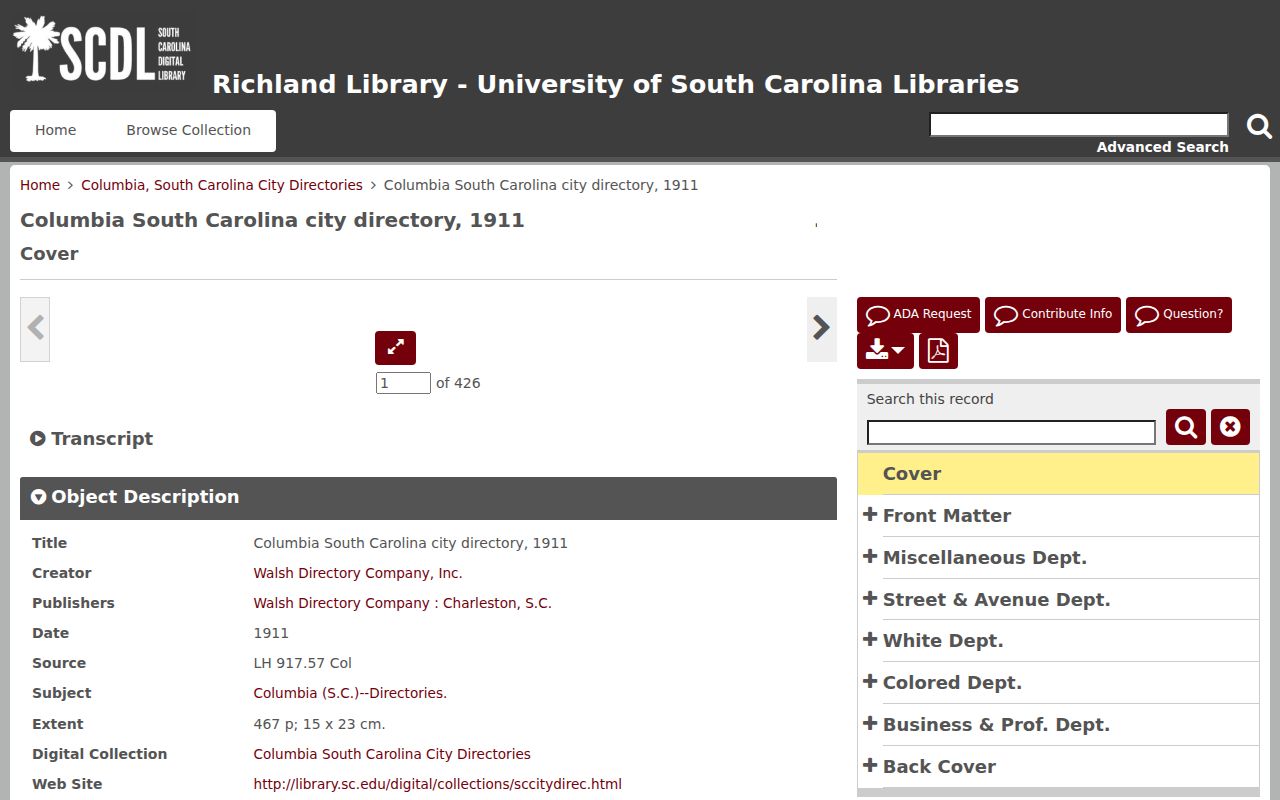
That edition contains Street & Avenue, White, Colored, and Business & Professional departments. Those historic labels belong to the source context and should be quoted only when needed to describe what the edition printed.
For an address, the Street & Avenue department can move the search from a block to an entry. For a person, an alphabetical listing can lead back to a street. Neither route makes the directory a complete roster, but together they offer a precise starting point for a specific publication year.
Richland County Library Directory Runs
Richland Library's Hill's Columbia directory holdings extend the local sequence after the early digitized run. Confirmed holdings include 1929-32, 1934-43, 1945, 1946-47, 1948-64, 1966-73, and 1978-79. The records note nearby areas such as Arcadia, Belvedere, Capitol View, and other places, which can help when a Columbia-area address does not fit a modern municipality label.
Local directory timeline
- 1859-1927: selected Columbia issues are digitized through the University of South Carolina collection.
- 1929-1979: Hill's supplies the documented local serial and selected later holdings at Richland Library.
- 1942 and 1954: digitized telephone materials add dated address and telephone evidence.
- 1985-1997: selected Polk volumes provide a later library bridge with a documented gap.
The Hill's entries are kept in the Main library's Local History reference/archive area for in-library use. Polk volumes supply later points for 1985-88 and 1990-97, but there is no basis for filling their gap by assumption. Match the year of a question to an actual held volume, then cite the edition instead of blending separate runs into one continuous account.
The library catalog record for Hill's Columbia directories displays the year-by-year local holdings.
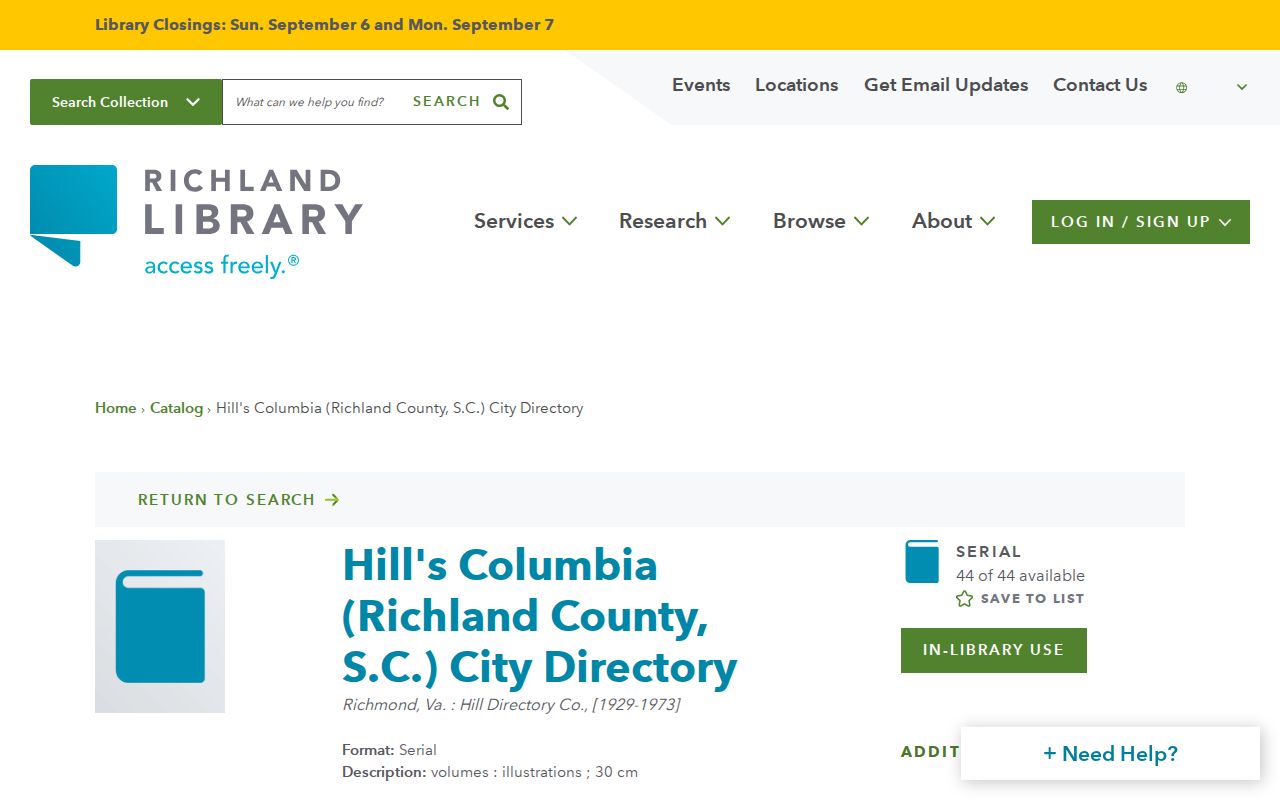
The catalog view helps a researcher plan an in-library visit around the years actually available, rather than expecting every issue in the serial to be on the shelf.
Walker Center Directory Research
The Walker Local and Family History Center is the practical local desk for directory work. It is on the First Level of Richland Library Main, 1431 Assembly St., Columbia, SC 29201. The center lists walk-ins, appointments, remote obituary requests, directories, newspapers and magazines, maps, yearbooks, oral histories, FamilySearch Affiliate access, and a scan station. Its posted hours are 9 a.m. to 6 p.m. Monday through Friday, 2 to 6 p.m. Saturday, and closed Sunday. The listed telephone number is 803-929-3402.
Its Local History Digital Collections broaden a historical directory search with maps, school yearbooks, photographs, oral histories, local-history and genealogy indexes, and collection finding aids. Those materials can date a neighborhood or add a classmate or family-history lead. They do not establish a current resident list.
The Richland Library digital collections landing page is the entry point for those digitized local-history materials.
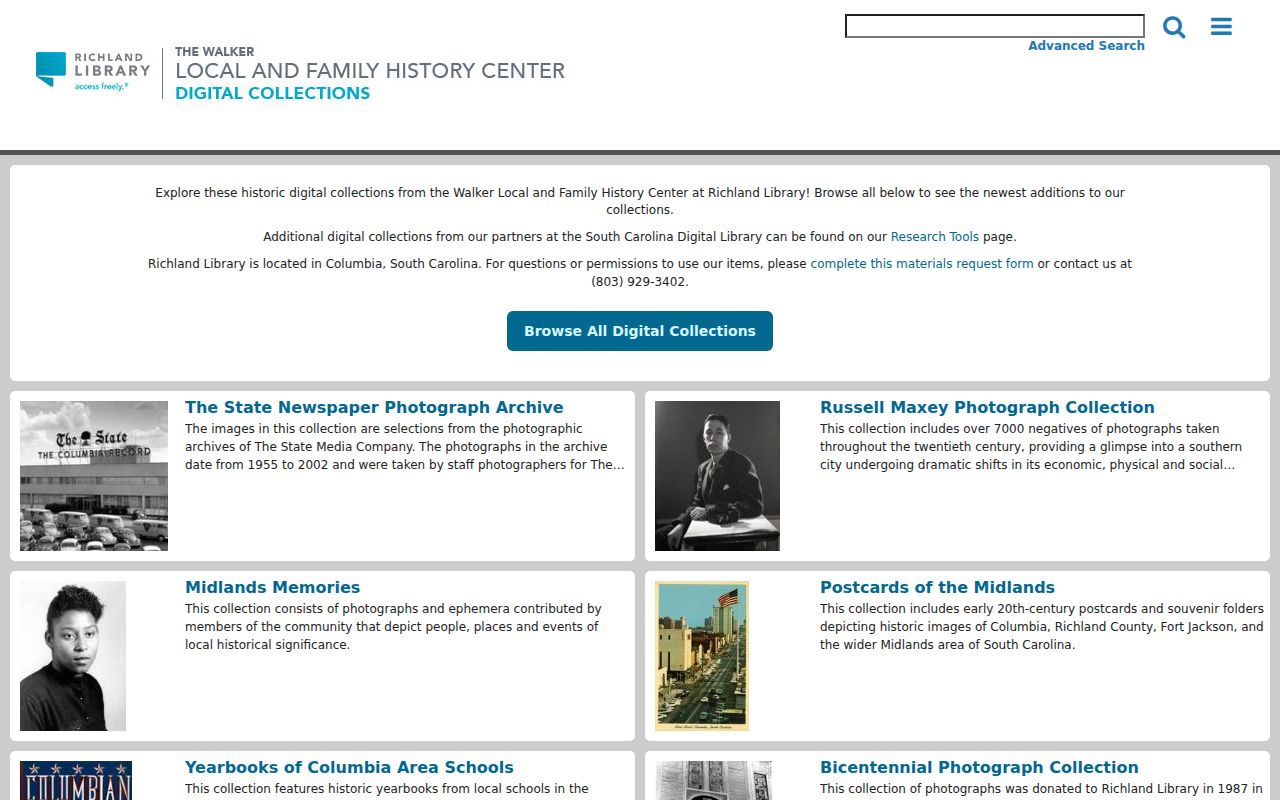
Use the digital collections beside a cited directory edition, especially when an address needs neighborhood or visual context that a printed listing cannot supply.
Reading a Richland County City Directory Entry
A visible 1954 Columbia telephone-directory page shows the elements a researcher should capture exactly: surname, initials or given names, status marks such as Mrs. or junior-type designations, occupation or business wording when published, the residence marker r, street address, locality tags, and a telephone number. Period abbreviations need the key in that same volume. A short line can be rich evidence, but it remains an editorial record created for its issue date rather than a government certification.
| Name form | Surname with initials or given names, plus any printed status or junior-type designation. |
|---|---|
| Period detail | Occupation or business/place wording, only where the edition includes it. |
| Residence marker | r and the printed street address, locality tag, or telephone number. |
| Edition context | Abbreviations and categories as they appear in that specific directory's own key. |
- Criss-cross directory
- An address-ordered directory section that can lead from a street address to the listing published for that edition.
- Householder index
- An index organized around a household or named listing, rather than a current census of everyone at an address.
- Abbreviation key
- The volume's explanation of its shortened forms. Read or copy it before expanding a mark in a research note.
Richland County Directory Street Context
Columbia's planned-grid origin in 1786 helps explain why directory Street & Avenue departments and plats are so useful for older research. A street name or number should still be checked against the parcel's legal description and a period map. Research did not identify one verified countywide renumbering year, so there is no safe shortcut from a modern street label to an older listing.
The Library of Congress Sanborn sequence offers 1888, 1919, and 1950 Columbia editions. The maps show street and building context for their dates, not household names. Pair a map sheet with a directory year and a parcel or deed reference when determining whether an address form and structure belong to the same historical place.
Trace a Richland County Directory Household
Household tracing works best as a dated sequence. Start from the known name or address, preserve the exact wording in the first issue, and compare the next available edition rather than jumping across a gap. A directory can identify an address or a likely family connection, but census, land, obituary, probate, map, and plat records answer different questions. The full address-by-address collection detail belongs with the Richland County Street Directory.
- Search the 1859-1927 digital collection with surname variants, initials, middle names, and apparent name changes.
- Check a Street & Avenue, criss-cross, or telephone listing when the starting fact is an address.
- Write down the edition year, name form, address wording, and any abbreviations before comparing another source.
- Use Hill's and Polk volumes at the library to bridge the documented later runs without hiding their gaps.
- Pair the directory observation with a federal census released under the National Archives 72-year timetable, then test it against deeds, maps, obituaries, or probate evidence.
When a name disappears, check the next actual volume, a spelling variation, an address change, the obituary index, or probate and deed evidence. The absence of a listing alone does not establish death, departure, or a move outside the county.
Note: Preserve each directory's edition year and page or image reference so later family research can distinguish a printed observation from a confirmed event.
Richland County Record Loss and Recovery
The February 1865 fire during federal occupation of Columbia destroyed the courthouse and most records, according to the South Carolina Archives Richland County Summary Guide. Most equity and probate records had been removed safely. This makes the fire a routing fact for early research, not a reason to repeat an unsuccessful modern index search or to assume that every early record vanished.
The SCDAH Research Room, at 8301 Parklane Rd. in Columbia, lists county-record microfilm indexes, county and municipal microfilm, census, wills, death-certificate indexes, and church, newspaper, and private records. Its posted hours are Tuesday through Friday, 8:30 a.m. to 5 p.m., and Saturday, 8:30 a.m. to noon and 1 to 5 p.m. The research-room telephone number is 803-896-6104.
The Archives guide documents surviving routes, including conveyance books from 1865 to 1951, a general RMC index from 1872 to 1908, tax duplicates, court series, and other county groups.
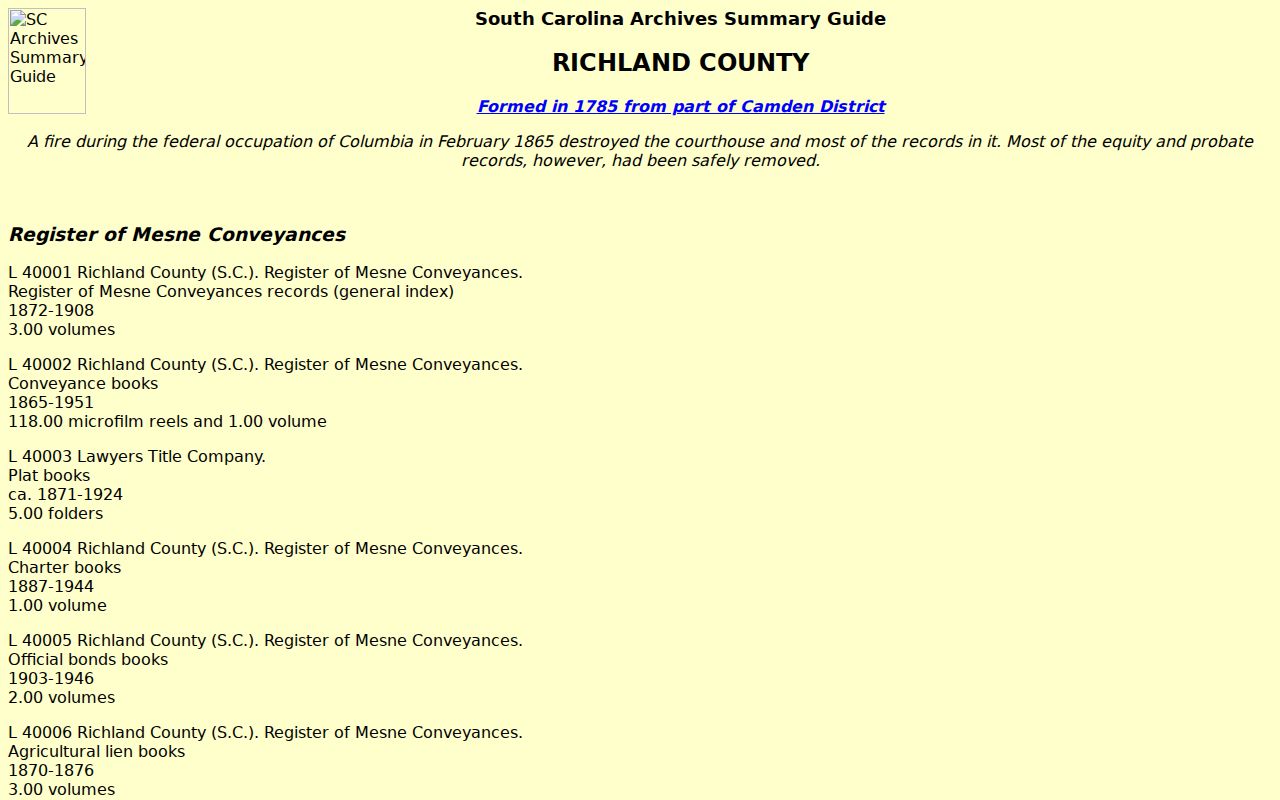
For a pre-fire trail, begin with the surviving equity or probate groups and the Archives holdings rather than treating a missing courthouse record as a complete answer.
Telephone Lists and Obituary Leads
Richland Library's digitized 1942 telephone directory and 1954 sample page add later address, telephone, and published occupation-style detail. They are issue-specific sources, not proof that every person at an address appeared in a telephone list. The Local History & Obituary Index adds death notices, local-news articles, magazines, and photograph holdings; staff add records and can provide copies.
Keep a telephone observation tied to its edition. A printed number or street address is a lead for that date, not evidence that every member of a household was listed or that the same number remained in use. Compare it with the address form in the closest directory issue, then use a census release, land record, obituary, or probate matter when the question calls for a different kind of confirmation. This preserves the difference between a publisher's listing and a custodian's record.
These local materials work well when a directory trail ends at an estate, obituary, or family notice. Cite the directory edition or index item, then seek the relevant custodian record if a date, property transfer, or estate question needs confirmation.